Learning how to declutter your home effectively starts with sorting items by room or category and prioritizing removal over the purchase of new storage containers. Success involves establishing a realistic timeline, focusing on one area at a time, and creating daily habits that prevent clutter from returning to your living space.
Most homeowners believe a trip to the storage aisle will solve their organizational woes, yet adding more bins often only masks the underlying chaos. True refinement begins with a deliberate edit of your environment rather than a new collection of plastic containers. When your living space feels heavy with excess, it detracts from the clarity and comfort your home should provide. This guide offers a sophisticated, practical approach to reclaiming your surroundings. We will move beyond the storage trap to explore foundational rules that actually work across every room. You will learn how to address the kitchen, living areas, and closets by focusing on utility and your current lifestyle. From managing seasonal transitions to letting go of your fantasy self, this room by room strategy ensures your home remains a curated sanctuary of purpose.
The Storage Trap: Why Buying Bins Won't Fix a Clutter Problem
Many homeowners start their journey of learning how to declutter your home by rushing to purchase matched sets of plastic bins. This is a tactical error. Buying storage containers before addressing the volume of your possessions simply creates organized clutter. A bin filled with items you do not use or need is still waste; it is just contained waste taking up valuable square footage in your house.
At Snow Shops, we believe in everyday solutions for home that emphasize utility rather than encouraging unnecessary consumerism. True organization begins with a rigorous editing process, not a shopping trip. The goal is to curate a reliable product selection within your own living space by removing items that no longer serve a functional purpose. You must learn to fit your belongings into the existing architecture of your home rather than expanding your storage footprint to accommodate excess.
Professional efficiency comes from deciding what is worth keeping, not from finding a more aesthetic way to hide things that should have been discarded months ago. Before you reach for a label maker or a new basket, you must first simplify your inventory. This shift in mindset ensures that your home remains a place of utility and comfort rather than a warehouse for unused goods.
Foundational Decluttering Rules That Actually Work

Transitioning from a mindset shift to physical action requires structure. Many homeowners feel paralyzed by the scale of the task, leading them to ask how to start when a house feels beyond repair. The answer lies in time-bound, low-friction rules that prioritize momentum over perfection.
The 5-5-5 rule is the most effective starting point for those who feel overwhelmed. Set a timer for five minutes and identify five items to address immediately. This removes the pressure of completing a whole room, focusing instead on rapid decision-making. Once the timer ends, you stop; this prevents the burnout that often halts decluttering efforts before they gain traction. This rule helps you maintain everyday solutions for home that actually serve your daily needs rather than letting them get buried under layers of neglected items.
For more targeted sorting, the 3-3-3 rule provides a simple framework for processing a single drawer or shelf. Identify three items to toss, three to donate to a local charity, and three to relocate to their proper home. This method prevents the relocation trap, where items are moved from one pile to another without ever finding a permanent spot or leaving the house.
When you are ready to tackle a larger zone, follow the Four Cs: 1. Clear out: Empty the space entirely to see the actual footprint you have available. 2. Categorize: Group similar items together to see the true volume of what you own. 3. Cut: Ruthlessly remove duplicates or damaged goods. 4. Contain: Return the remaining items to the space using existing dividers or trays.
Establishing these foundational habits ensures that your reliable product selection at home remains functional. If you find yourself stuck or needing specific tools for upkeep, contact us for household essentials that aid in maintaining an orderly environment. By applying these lazy decluttering rules, you turn a daunting project into a series of manageable tasks, making it much easier to learn how to declutter your home without needing a weekend-long overhaul.
The Kitchen: Reclaiming Prime Real Estate and Reducing Duplicates

Once you have established the foundational rules, applying them to the kitchen is the next logical step. This room is the functional core of any household, yet it often suffers from prime real estate congestion. The prime real estate rule dictates that only items used every single day should remain on your countertops or at eye level in the cabinets. If you only use a stand mixer once a month, it does not belong on the counter. Move it to a lower shelf or a pantry to reclaim valuable workspace.
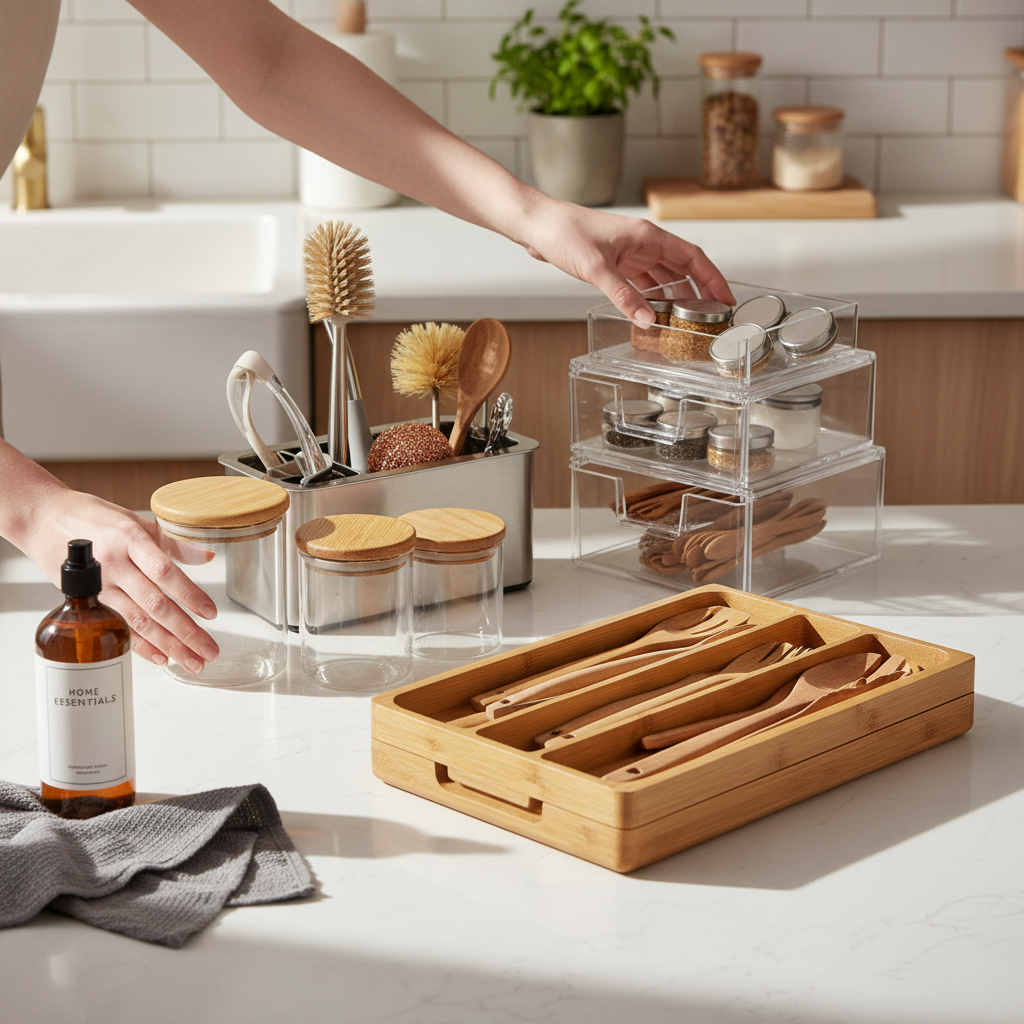
Audit your drawers for duplicates. Most households possess three sets of measuring cups and a dozen mismatched spatulas; keep the highest quality set and donate the rest. This simplifies your workflow and ensures you are working with a reliable product selection of tools. Prioritize multi-use items like a versatile chef knife over single-use gadgets such as avocado slicers or strawberry hullers. These specialized tools often take up disproportionate space relative to their utility. By focusing on everyday solutions for home, you ensure your kitchen remains a workspace rather than a storage locker.
Before purchasing inserts, use existing resources to refine your layout. Cut down small cardboard delivery boxes or use shoeboxes as temporary drawer dividers. This allows you to test a configuration for a few weeks before committing to a permanent solution. Check your pantry for expired goods and consolidate half empty boxes of the same ingredients. If you find your kitchen lacks the fundamental gear required for efficiency, you can contact us for household essentials that prioritize long-term utility. This practical approach is essential when learning how to declutter your home effectively.
Living Spaces: Clearing Flat Surfaces and Sentimental Stagnation
Moving from the kitchen to the living room reveals a different challenge; flat surface syndrome. Coffee tables, mantels, and side tables frequently become dumping grounds for mail, keys, and miscellaneous objects. These horizontal planes act as staging areas for delayed decisions, quickly causing a room to feel chaotic.
To reclaim these areas, implement the One-Touch Rule. This systematic habit prevents clutter from accumulating by requiring you to make an immediate decision about an object rather than dealing with it later. 1. Pick up the arriving item. 2. Identify its permanent home. 3. Put it away immediately instead of setting it down temporarily.
For items that must remain in the room, such as remote controls or reading glasses, use existing shallow bowls, trays, or baskets to corral them. This defines a clear boundary for everyday solutions for home utilities without buying new organizers.
Understanding how to declutter your home also requires addressing the sentimental stagnation that stalls progress in living spaces. You do not need to keep an entire collection of inherited items or every vacation souvenir to honor a memory. Select the single best piece that carries the strongest emotional connection, display it prominently, and safely discard or donate the remainder. This targeted curation ensures your living space remains functional.
Closets and Bedrooms: The Hanger Flip and the Fantasy Self
Transitioning from public living areas to private sanctuaries requires a more personal editing process. The bedroom and closet often become catch-all zones for items we hope to use one day, but utility must remain the priority. To identify what truly belongs in your wardrobe, use the Reverse Hanger Method. Turn every hanger in your closet so the hook faces toward you. Once you wear an item and return it from the laundry, hang it the standard way. After six months, any hanger still facing backward identifies a garment that has not been used. These items are prime candidates for donation.
Effective wardrobes also require confronting the concept of the fantasy self. Many residents keep formal gowns or business suits for a lifestyle that is strictly casual, or save clothing that no longer fits in hopes of a future body change. A closet should be a collection of everyday solutions for home and work that fit your current reality. Storing clothes for a version of yourself that does not exist creates mental friction and physical crampedness.
In Fillmore, our climate necessitates a strict seasonal rotation. Do not allow heavy winter parkas and thermal boots to occupy prime reach zones during the heat of July. Move off-season gear to higher shelves or secondary storage areas to ensure your reliable product selection of current clothing remains accessible. If you find your current storage layout lacks the necessary structure for these transitions, you can contact us for household essentials to help streamline your space. Mastering how to declutter your home in these personal areas ensures your morning routine starts with efficiency rather than a search through unused excess.
Bathrooms and Linens: Managing Expiration Dates and Bulk Buys
Bathrooms often harbor the most outdated inventory in a household. Begin by emptying the medicine cabinet and checking every expiration date. Active ingredients in sunscreen, eye drops, and ointments lose efficacy over time, and using expired products can be a safety risk. Discard anything past its date, along with nearly empty bottles you have not touched in months. This ensures your vanity remains a space for functional, daily care rather than a graveyard for forgotten prescriptions.
In the linen closet, the most effective way to manage volume is the two-set rule. For every bed and bathroom, you only need one set of linens in use and one set in the wash. Storing five sets of sheets for a single guest bed creates unnecessary bulk. By limiting your inventory to what is actually required for a weekly laundry rotation, you reclaim shelf space and simplify the process of putting away clean laundry.
Buying in bulk often seems economical, but it incurs a hidden storage cost. Without a designated overstock zone, excess items overflow into active living areas, defeating the purpose of an organized space. At Snow Shops, we provide everyday solutions for home that focus on what you need now. A reliable product selection should not require you to sacrifice square footage for a six month supply of soap. If you are struggling with a crowded vanity, you can contact us for household essentials that offer immediate utility. Learning how to declutter your home in the bathroom means keeping only what is safe, current, and necessary.
Seasonal Rotation: Managing Mudrooms and Garages in Fillmore

In Fillmore, the transition between seasons is sharp, requiring mudrooms and garages to work twice as hard. Managing these high traffic zones effectively depends on the immediate accessibility of your gear. During a Utah winter, snow shovels, ice melt, and heavy boots must be at the front. As the weather warms, these items should be moved to the back or higher shelving to make room for hiking packs and yard tools.
To successfully execute how to declutter your home in these utility spaces, categorize items by activity rather than object type. Grouping all trail gear or irrigation supplies together allows you to quickly assess what you actually use. Racks that hold bikes or skis should be cleared of anything that is not currently in season. Moving off-season equipment to secondary storage prevents the clutter that occurs when you have to dig through snow gear to find a garden trowel.
Safety is paramount in garages; you must clear the floor. A floor covered in loose gardening pots or boots feels cramped and dangerous. Utilize wall space or existing shelves for your reliable product selection of tools. If you find your mudroom lacks the functional hooks or racks needed to keep gear off the ground, you can contact us for household essentials that provide everyday solutions for home maintenance. By rotating your inventory every six months, you ensure that only the tools necessary for the current Fillmore climate occupy your prime workspace.